Piña: a heritage textile
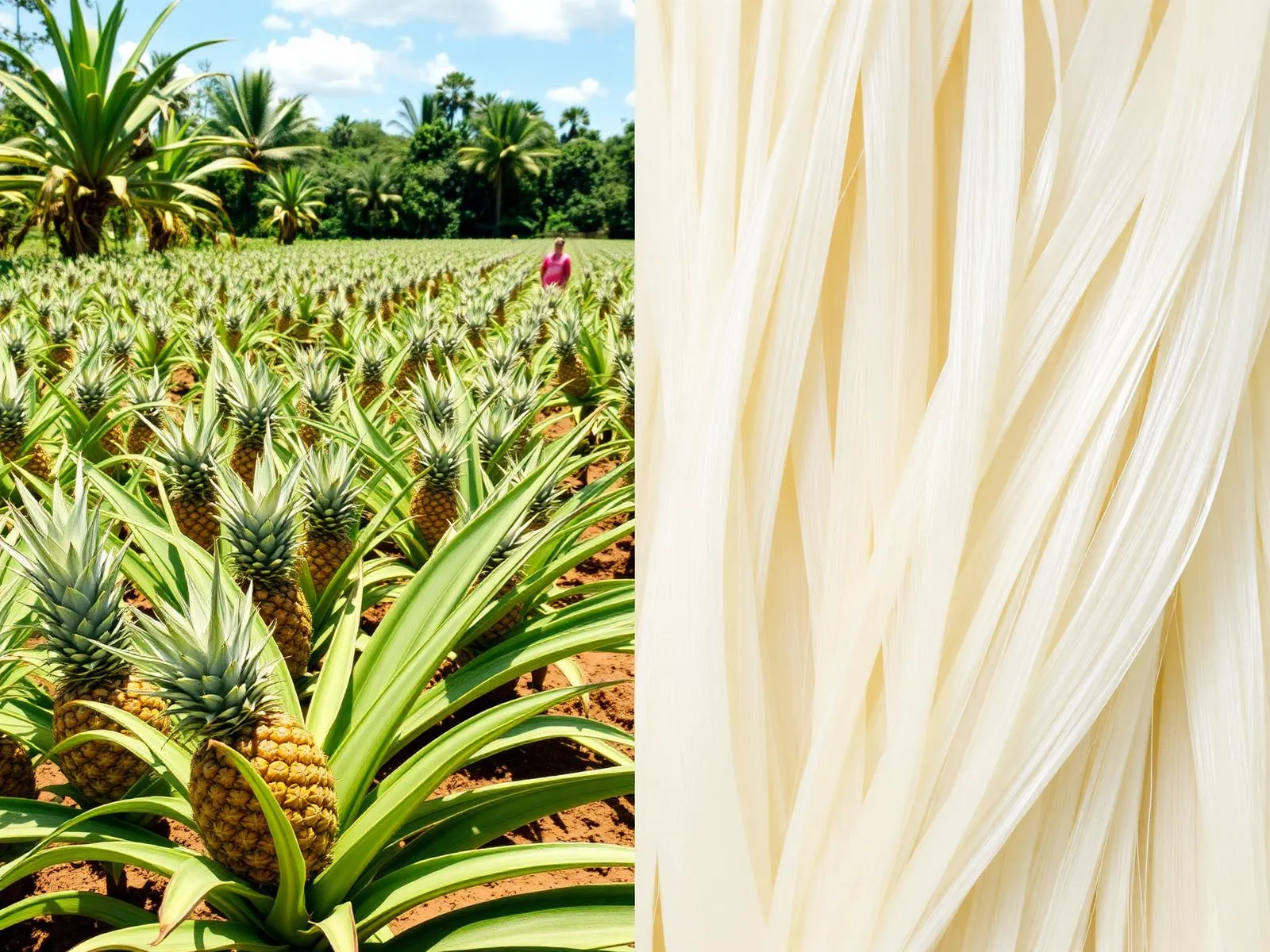
Long before life-cycle assessment existed, weavers in the Philippines were hand-extracting pineapple leaf fiber, knotting it filament by filament, and weaving piña — a translucent, faintly golden cloth reserved for ceremonial dress and, later, for the barong tagalog. Piña travelled through colonial trade routes as a luxury comparable to fine silk, precisely because the fiber is fine, lustrous and unusually strong for its diameter.
That heritage is not decoration on a spec sheet. It is evidence: a fiber that could be hand-processed into gossamer cloth two hundred years ago has the intrinsic fineness and cellulose alignment that modern mills want. What held it back was labour intensity. Mechanical decortication and modern degumming are what turn a heritage craft fiber into a supply-chain material.
Properties
PALF's performance comes from its structure: high cellulose content, low lignin relative to most bast fibers, and a low microfibrillar angle, which means the cellulose chains run closely parallel to the fiber axis. That alignment translates directly into tensile strength and stiffness, and it also produces the characteristic sheen.
| Property | Typical range | Note |
|---|---|---|
| Tensile strength | 400–1,600 MPa | Wide range; cultivar and test dependent |
| Young's modulus | 30–80 GPa | High for a natural fiber |
| Elongation at break | 1–3% | Low stretch; blend for apparel |
| Cellulose content | 70–80% | Drives strength and lustre |
| Lignin content | 5–12% | Lower than jute or coir |
| Density | 1.4–1.5 g/cm³ | Well below glass fiber |
Practically, this makes PALF a fiber of two personalities. Fine, well-degummed grades behave like a lustrous bast-silk hybrid and belong in apparel and home textiles. Coarser grades behave like a high-modulus reinforcement and belong in non-wovens and composites. Grading is therefore the whole game.
Processing
Leaves are collected soon after harvest, while still green and pliable. Mechanical decortication scrapes the pulpy leaf tissue away from the fiber bundles; the residue is retained as biomass rather than discharged. Extracted fiber is washed, degummed to remove pectins and waxes, dried, then combed and graded on fineness, length and colour.
Because PALF is naturally stiff, downstream softening — enzymatic or mechanical — is specified against the end use. A spinner producing a 30% PALF / 70% cotton blend wants a different softening profile than a non-woven producer building a leather-alternative substrate, and both differ from a composite compounder who wants the gums gone and the moisture low.
Applications
Apparel. Blended yarns for shirting, summer suiting, structured dresses and accessories, where PALF contributes lustre, dry hand, breathability and strength. Blends with cotton, lyocell, linen or silk are the norm.
Home textiles. Curtains, table linen, cushion covers, rugs and upholstery fabrics benefit from PALF's dimensional stability, abrasion resistance and natural sheen.
Leather alternatives and non-wovens. Needle-punched PALF webs form the base of plant-based leather substitutes and technical non-wovens for filtration, insulation and geotextiles.
Composites. Its high modulus makes PALF an effective reinforcement in bio-resin panels, interior trim and moulded components where weight matters.
Sustainability profile
Pineapple leaves are among the most consistently burned agricultural residues, because growers need the field cleared quickly for replanting. Every tonne of leaf diverted into fiber avoids that open burning and its particulate and greenhouse emissions, and pays the grower for material that was previously a disposal cost.
As with all Ecovasa fibers, no land, irrigation or fertiliser is attributed to fiber cultivation — the crop was grown for fruit. The cradle-to-gate burden is collection, decortication, degumming and drying, which is why we keep collection radii tight and prioritise mechanical over chemical routes.
| Criterion | PALF | Silk | Cotton | Viscose |
|---|---|---|---|---|
| Feedstock | Fruit-crop residue | Sericulture | Dedicated crop | Wood pulp |
| Land use for fiber | None | Mulberry cultivation | High | Forestry |
| Chemical intensity | Low (mechanical) | Moderate | Moderate–high | High (solvent) |
| Lustre | High | Very high | Low | High |
| Tensile strength | Very high | High | Moderate | Low–moderate |
| Animal-derived | No | Yes | No | No |
| Biodegradable | Yes | Yes | Yes | Yes |
Sourcing from Ecovasa
We aggregate pineapple leaves through grower partnerships, extract mechanically, and grade for the buyer's process rather than to a single generic spec. Trial quantities, specification sheets and origin documentation are available for mills, non-woven producers and composite manufacturers.