A crop with two useful halves
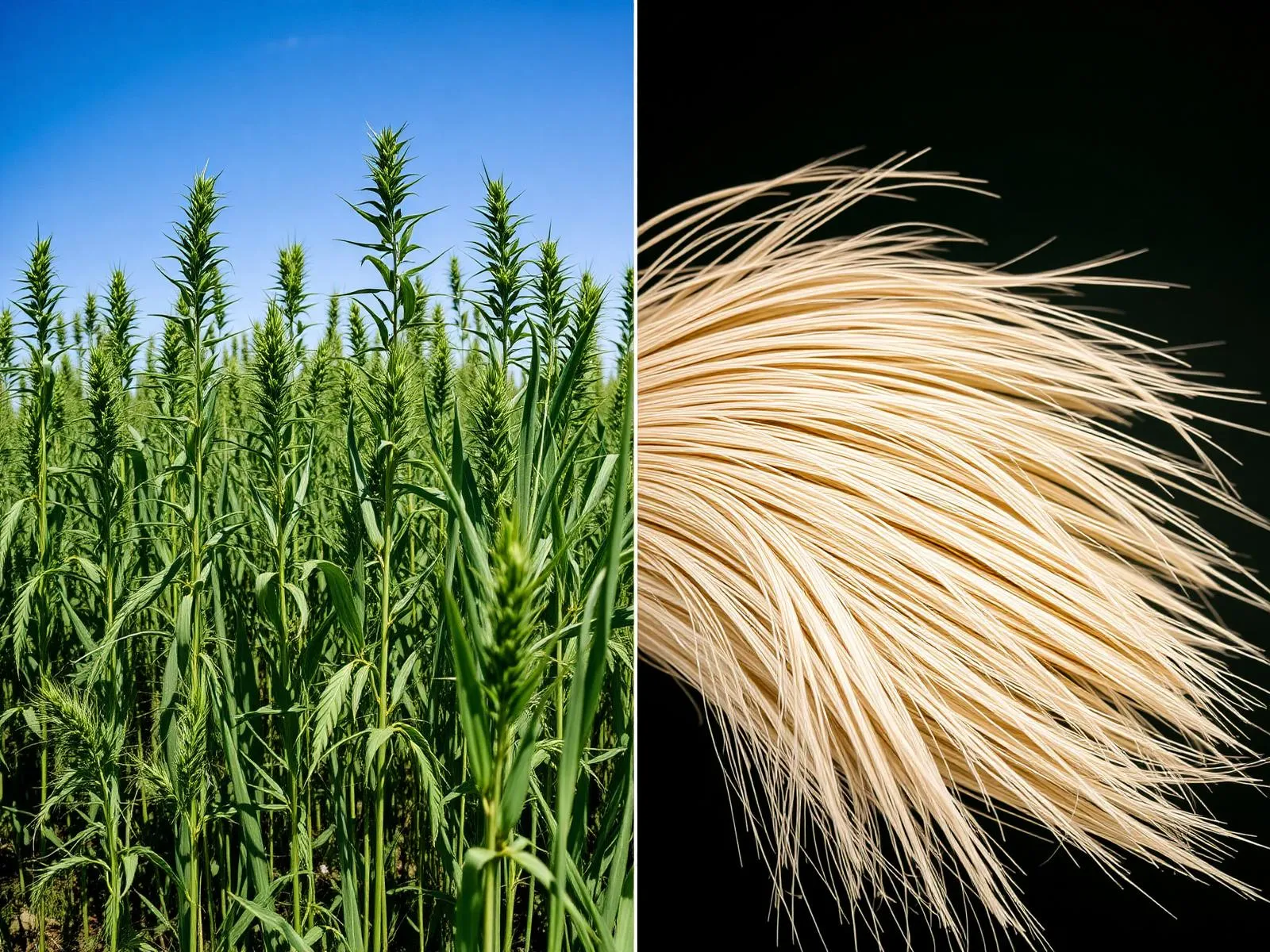
A hemp stalk is a natural composite. The outer bark carries long bast fiber bundles running the full length of the stem; the inner core is a woody, highly absorbent pith called hurd or shiv. A fiber-grade crop reaching three to four metres in a hundred-day season yields both, and a viable hemp economy sells both — bast into textiles and composites, hurd into bedding, hempcrete blocks, particle board and mulch.
Agronomically, hemp is unusually undemanding. It grows densely enough to shade out weeds without herbicide, tolerates a range of soils, needs markedly less water than cotton, and returns leaf matter and root structure that improve soil condition for the following crop. It is also a genuine rotation crop rather than a monoculture, which matters for the farmer partnerships Ecovasa builds around fiber supply.
Mechanical properties
Hemp bast is roughly 70–75% cellulose with low lignin relative to woody fibers, giving high stiffness with reasonable ductility. Reported values vary widely because natural fiber testing is sensitive to gauge length, fiber diameter measurement and retting degree — a well-retted, carefully scutched fiber can outperform a poorly processed one from the same field by a factor of two.
| Property | Typical range | Note |
|---|---|---|
| Tensile strength | 550–900 MPa | Retting quality dominates variability |
| Young's modulus | 30–70 GPa | High stiffness for a natural fiber |
| Elongation at break | 1.6–4% | Low stretch, high stiffness |
| Density | 1.4–1.5 g/cm³ | ≈ half of E-glass (2.5–2.6) |
| Cellulose content | 70–75% | Low lignin vs. woody fibers |
| Moisture regain | 8–12% | Dry before compounding |
From stalk to specified fiber
Retting is the decisive step. Field (dew) retting is cheapest and lets soil microbes loosen the pectin bond over two to four weeks, but it is weather-dependent and variable. Water and enzymatic retting are faster and far more consistent, at the cost of effluent handling or enzyme cost. Ecovasa favours controlled retting with water recirculation, because batch consistency is what converts a natural fiber from a curiosity into a purchasable industrial input.
Retted stalks are dried, then broken and scutched — mechanically crushed and beaten so hurd falls away and bast is released. Hackling or refining aligns and cleans the fiber to the fineness a spinner needs; composite buyers instead take cut, dried and lightly opened fiber sized to their compounding line. Every lot leaves with length, fineness, moisture and residual shive figures on the specification sheet.
Biocomposite and automotive applications
European carmakers have used natural fiber reinforced polypropylene and thermoset panels in door cards, parcel shelves, boot liners and headliners for two decades, largely because they cut part weight by 10–30% against glass-filled equivalents. Hemp is a preferred reinforcement in that segment: it is non-abrasive to tooling, gives good acoustic damping, and produces press-moulded parts with acceptable surface quality behind a trim skin.
In construction, hemp hurd bound with a lime binder makes hempcrete — a non-structural infill with strong hygrothermal performance and negative embodied carbon over its service life. Hemp bast non-wovens serve as insulation batts with competitive thermal conductivity and none of the handling issues of mineral wool.
| Criterion | Hemp | E-glass | Flax | Cotton |
|---|---|---|---|---|
| Density (g/cm³) | 1.4–1.5 | 2.5–2.6 | 1.4–1.5 | 1.5–1.6 |
| Tensile strength | 550–900 MPa | 2000–3000 MPa | 500–900 MPa | 290–600 MPa |
| Specific stiffness | High | Moderate | High | Low |
| Embodied energy | Low | High | Low | Moderate |
| Tool abrasion | None | High | None | None |
| End of life | Biodegradable | Landfill | Biodegradable | Biodegradable |
| Water use in cultivation | Low | n/a | Low | Very high |
Regulatory context
Industrial hemp is legally distinct from narcotic cannabis by THC content — internationally the threshold is 0.2–0.3%, and fiber cultivars are bred well below it. In India, cultivation is permitted under state licensing within the NDPS Act framework, with Uttarakhand first to formalise a policy and Uttar Pradesh and Madhya Pradesh following with their own routes. Seed variety, plot registration and testing obligations sit with the licensed cultivator.
For buyers, the practical implications are documentation-shaped: proof of licensed origin, THC test results for the lot, and export paperwork that classifies the material as industrial fiber. Ecovasa handles that chain so the material arrives with the evidence a compliance team asks for.
Sourcing from Ecovasa
We supply graded hemp bast fiber and hurd from licensed Indian cultivation, with traceability back to the grower group. Trials start small — enough fiber to run your line and test parts — and scale into contracted volumes with agreed specifications. Ecovasa is recognised under Startup India, MSME and StartinUP, incubated at SIIF, UPTTI Kanpur, and a member of FIBRAL and DNFI.