Where the fiber comes from
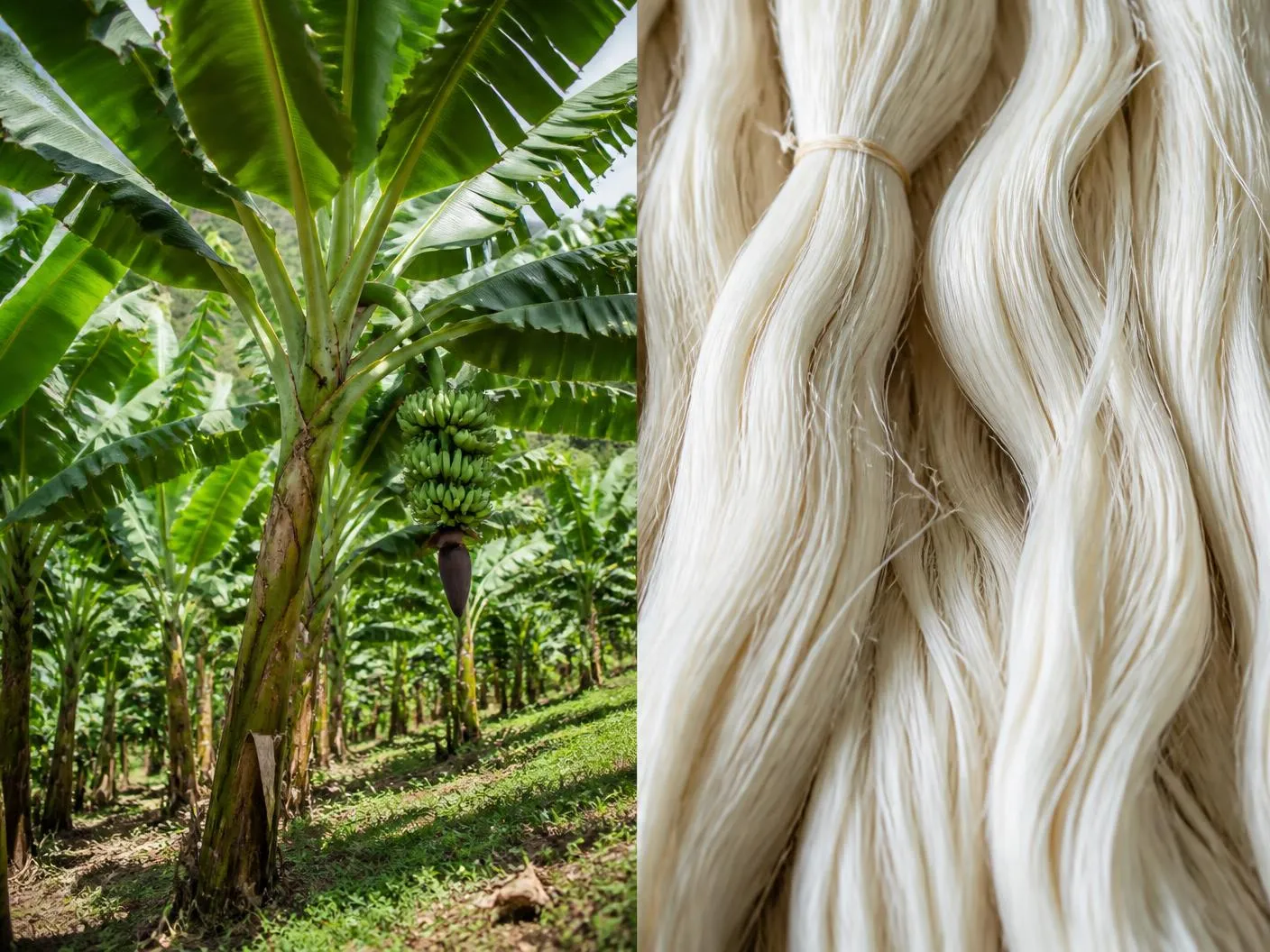
A banana plant fruits once. After the bunch is cut, the pseudostem — the tightly packed cylinder of leaf sheaths that looks like a trunk — has no further use to the grower. Across India alone, banana cultivation covers close to a million hectares, and each hectare leaves behind tens of tonnes of wet pseudostem biomass every season. Most of it is left to rot at the field edge, ploughed in, or burned.
Inside those sheaths sit long, aligned cellulose bundles. Historically they were extracted by hand across South and Southeast Asia for cordage, mats and paper. What changed is the demand side: brands, packaging converters and automotive tier suppliers now need cellulose fiber that is traceable, non-food-competing and demonstrably circular. A residue with no land footprint answers that need better than almost any cultivated fiber can.
Properties
Banana pseudostem fiber is lignocellulosic: roughly 60–65% cellulose, 6–19% lignin, and the balance hemicellulose, pectin, waxes and moisture. The exact split varies by cultivar, plant age and which sheath layer the fiber came from — outer sheaths give coarser, stronger fiber, inner sheaths give finer, softer fiber suited to apparel blends.
That structure produces a fiber that is stiff, highly absorbent, naturally flame-resistant compared with synthetics, and dimensionally stable when dry. Its moisture regain is high, which is an advantage in textiles and a variable to control in composite moulding, where fiber is normally dried to a specified moisture content before compounding.
| Property | Typical range | Note |
|---|---|---|
| Tensile strength | 500–800 MPa | Cultivar and test-standard dependent |
| Young's modulus | 8–32 GPa | Higher for outer-sheath grades |
| Elongation at break | 1–3.5% | Low stretch; blend for apparel |
| Density | 1.3–1.4 g/cm³ | Lighter than glass fiber (~2.5) |
| Cellulose content | 60–65% | Drives strength and dye affinity |
| Moisture regain | 10–13% | Dry before composite compounding |
Processing
Ecovasa's process is mechanical first. Pseudostems are collected within a short window of harvest, while moisture content is still high and fiber separates cleanly. Sheaths are stripped and fed through a raspador-type decorticator whose rotating blades scrape away parenchyma pulp and leave the fiber bundles intact. The pulp and sap fractions are separated for secondary use rather than discharged.
Fiber is then washed, dried, softened where the end use requires it, and graded on length, fineness, colour and residual gum. Grading matters commercially: a composite buyer wants consistent length and low moisture, a spinner wants fineness and uniformity, and a moulded-pulp producer cares mostly about freeness and cleanliness. We avoid chemical retting, which is faster but produces effluent loads that undermine the point of the material.
Applications
Textiles and apparel. Blended with cotton, lyocell or recycled fibers, banana fiber adds strength, structure and a dry hand. It is widely used in home textiles, bags, upholstery and structured garments rather than next-to-skin knitwear.
Non-wovens and packaging. Needle-punched and wet-laid non-wovens made from banana fiber serve as void fill, agricultural mulch mats, and protective packaging that composts at end of life instead of entering plastic waste streams.
Biocomposites. As a reinforcement in PLA, PP or bio-epoxy matrices, banana fiber delivers a favourable specific-strength-to-weight ratio at roughly half the density of glass fiber, with far lower processing energy and no end-of-life landfill penalty.
Cordage, paper and craft. The oldest uses remain viable at scale: ropes, twines, specialty papers and handmade products that support rural livelihoods around the collection network.
Sustainability profile
The decisive fact about banana fiber is the counterfactual. The biomass already exists; the question is only whether it rots, burns, or becomes a material. Diverting it avoids open-field burning emissions and methane from anaerobic decomposition, and it substitutes for fibers that do carry a cultivation burden.
Because no irrigation, fertiliser or land is allocated to the fiber itself, its cradle-to-gate impact is dominated by collection logistics, mechanical extraction energy and drying. Keeping collection radii short and using ambient drying where climate allows are the two biggest levers, and both are designed into how Ecovasa sites its operations.
| Criterion | Banana fiber | Cotton | Jute | Polyester |
|---|---|---|---|---|
| Land use for fiber | None (residue) | Dedicated cropland | Dedicated cropland | None (petro) |
| Irrigation for fiber | None | Very high | Rain-fed to moderate | None |
| Feedstock origin | Agricultural residue | Agricultural crop | Agricultural crop | Fossil |
| Biodegradable | Yes | Yes | Yes | No |
| Microplastic shedding | None | None | None | Yes |
| Relative tensile strength | High | Moderate | High | High |
| Softness | Moderate (blend) | High | Low | Moderate |
Sourcing from Ecovasa
We work directly with banana growers and farmer groups, paying for biomass that previously cost them time and money to clear. Buyers receive graded fiber with a documented origin, sample quantities for trials, and specification sheets tailored to the end process — spinning, non-woven, moulding or compounding. Ecovasa is recognised under Startup India, MSME and StartinUP, incubated at SIIF, UPTTI Kanpur, and a member of FIBRAL and DNFI.